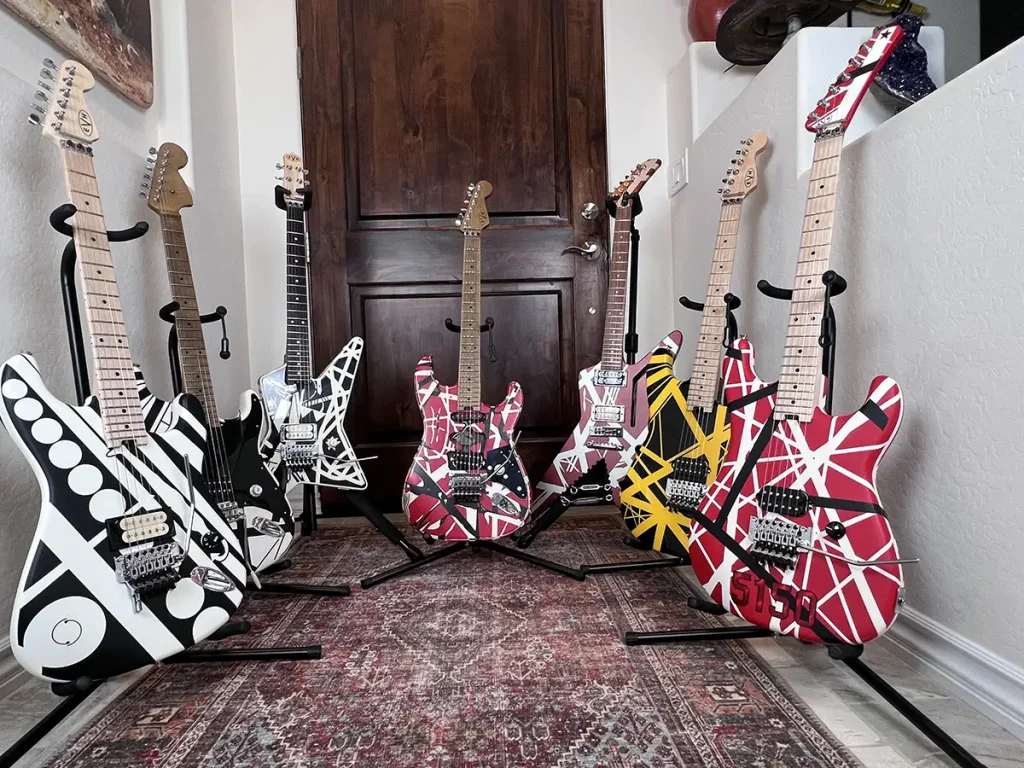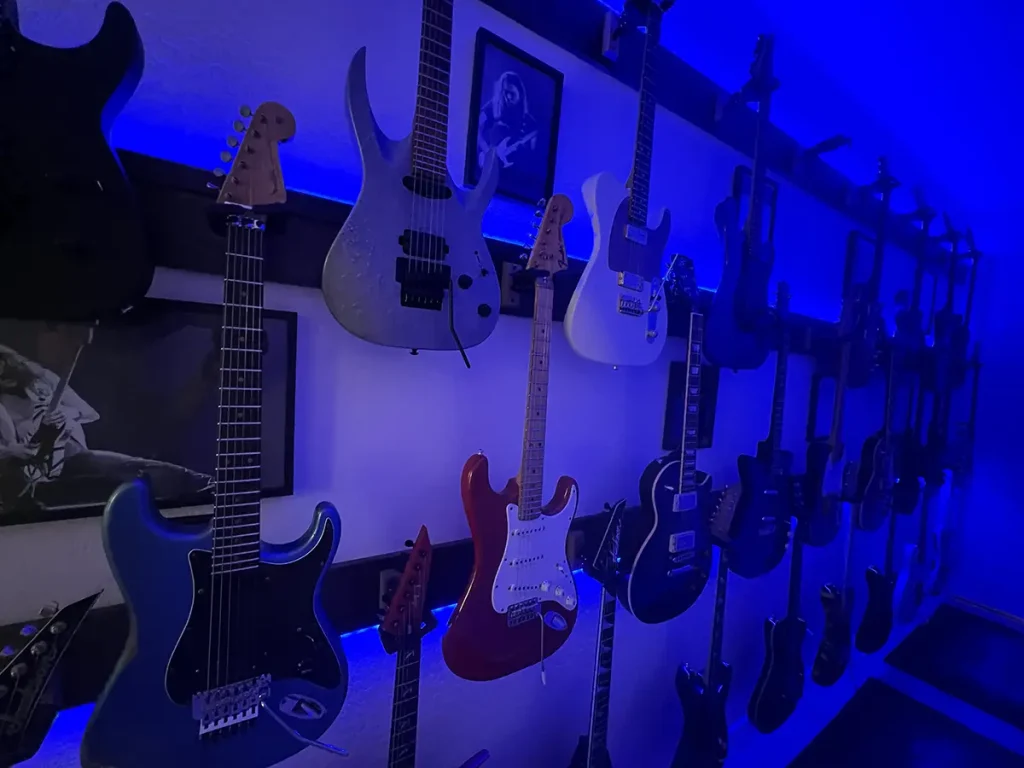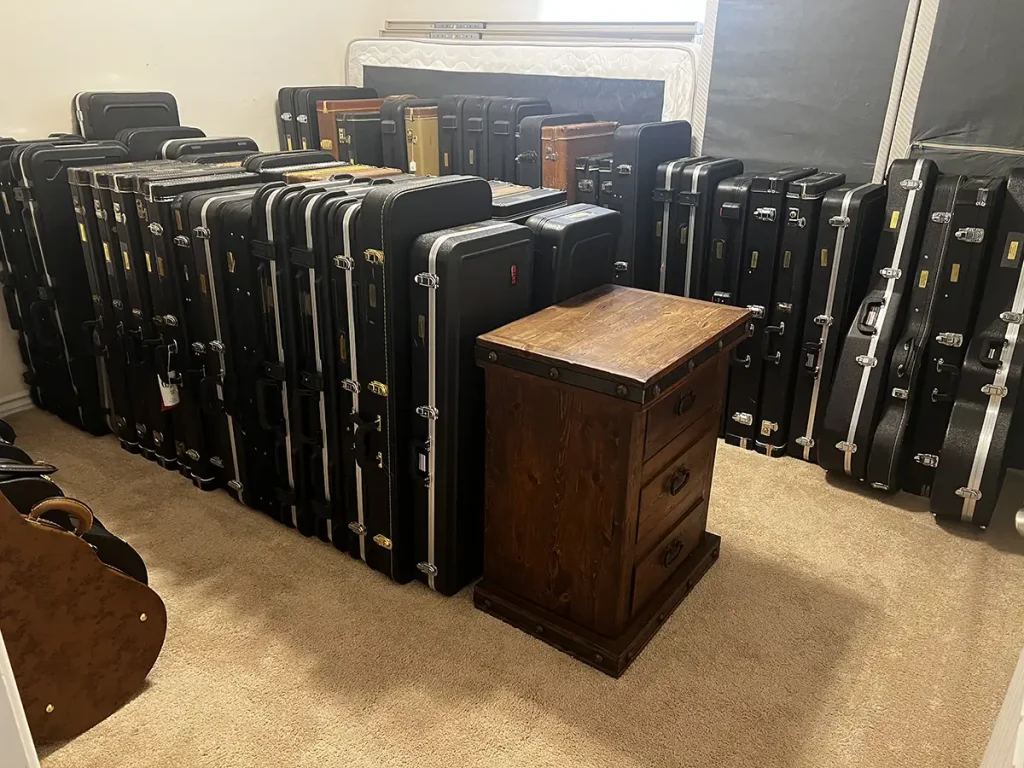
I get asked this a lot: Why So Many Guitars?
Well, this because at some point, I stopped chasing the idea of the one “perfect” guitar.
What I started chasing instead was something much more useful: What each guitar actually does better than anything else.
That is a very different game.
And it is exactly how you end up with more than 125 guitars while slowly realizing you may only need a small handful of them.
This is not about collecting every possible configuration just to say I have it. It is about sorting out which types of electric solid body guitars really earn a place in my hands, in my room, and on a recording.
Telecasters: Simple, Sharp, and More Useful Than I Expected
A plain old Telecaster is still one of the most useful guitars to have around. Two single coil pickups. No fancy electronics. No extra hardware. Just a straightforward guitar that does its job exceptionally well.
I used to think Telecasters were really only for country music. Over time, that idea completely fell apart. I have come to appreciate them for clean metal tones, for funk rhythm work, and for parts that need to sound crisp, focused, and honest.
They do not hide behind complexity. They force the part to be good. And when the part is good, a Telecaster can sound fantastic.
Stratocasters: A Sound Nothing Else Really Replaces
A plain Stratocaster is another category I always want around, but with one important condition: I have to move the volume knob. In the stock position, it is always in my way. Once that problem is fixed, a Strat becomes one of the most expressive guitars there is.
The five-way selector and three single coil pickups create a range of sounds that you just do not get from anything else. There is a kind of sparkle and texture there that makes a Strat its own instrument, not just another variation on a theme.
But, for certain clean tones, edge-of-breakup sounds, and layered rhythm parts, there is still nothing quite like it.
At last count, I have seven Stratocasters and three of them stand out as just sounding better than the others, and I really prefer a rosewood neck, and I cannot abide by the Strats that have a ton of clear coat on the back of the neck and the fretboard.
Super Strats: The Workhorse Middle Ground
Super Strats may be the most practical category of all. My definition is pretty simple: a Strat-style guitar with the standard four-bolt heel and a humbucker replacing the single coil at the bridge.
Again, I want the volume knob moved out of the standard position. Once that is done, I have a very versatile guitar that can cover a lot of ground.
A Super Strat gives me some of the familiar feel and flexibility of a Strat, but with more authority at the bridge. It is not always my first choice for soloing high above the 12th fret, but it can get there when needed. For a lot of real-world playing, it is one of the most useful formats ever invented.
Shredders: Built to Actually Be Played
Then there are the Shredders.
These are not defined by one exact pickup layout. I have them in single humbucker configurations, two humbuckers, one humbucker and two single coils, and my favorite: one humbucker and one single coil.
What really defines a shredder to me is larger frets and great access at the heel. That is what turns soloing above the 12th fret from a chore into something that actually feels good. These guitars are designed to let the player move without fighting the instrument.
That makes a huge difference. Some guitars sound great, but make you work harder than necessary. A true shredder removes barriers. It invites you to play more, push farther, and stay up there as long as you want.
The Bridge Question Matters
Within the shredder category, there are really three important sub-categories: hard-tail bridges, bridges that only go down for dive bombs, and bridges that float and go up and down.
For most applications, I prefer a hard-tail or a bridge that only goes down. Both are generally more stable. Both tend to offer better tuning stability. And both usually make the guitar easier to live with day to day.
But there are still times when only a floating tremolo will do. Sometimes you need that flutter. Sometimes you want the ability to pull the pitch up. Sometimes the bridge itself becomes part of the expression. So even though I do not prefer a floating setup for everything, I still understand exactly why it exists.
Les Pauls: Their Own Category for a Reason
Les Pauls live in their own category because I usually think of them differently. In many cases, I would be less likely to grab one for casual playing, but much more likely to grab one for recording.
That is because a really good Les Paul is often more stable, especially for lower-position parts, clean chord work, and layered rhythm tracks where you want the guitar to behave and stay in tune with less effort.
Having some with humbuckers and some with P90s gives me options. Humbuckers bring thickness and power. P90s bring bite, edge, and a little extra attitude. The point is not that one is better than the other. The point is that both can be right, depending on the part.
The Categories Still Under Investigation
Not everything in the collection has found a clear role yet.
I do have some semi-hollows, but so far I have not really found where they fit into what I like playing or recording. I can appreciate what they do, but I have not yet hit that moment where one of them becomes the obvious answer to a musical problem.
I have also just begun to explore baritone and extended scale guitars. I have not gone far enough with them yet to say what I like or do not like. There is clearly something there, but I am not ready to write the verdict yet.
And I do not have any 7-string, 12-string, or other odd extended-range configurations, mostly because I just have not had enough access to them. That is not really a statement against them. It just means they are outside my current experience.
The Wildcards Are Fun, But They Are Not the Core
I also have a lot of weird stuff.
Actually, I have quite a bit of it.
Things like a Roland GR707 that I turned into a hybrid shredder and Les Paul-style guitar. That neck brace makes it very stable, and it ended up becoming something unusual but useful. I also have a lot of Jackson and Gibson Flying Vs, Explorers, and other shapes that definitely have a personality.
But the truth is, those are not the guitars I use on a very regular basis.
They are interesting. They are cool. They may even be great in the right moment. But they are not the core categories I keep coming back to when I am trying to sort out what really works best for me.
So Why More Than 125 Guitars?
Because this is how you figure it out.
You do not figure it out by reading spec sheets. You do not figure it out by assuming one guitar can cover every situation. And you definitely do not figure it out by buying one of each major type and declaring the search over.
You figure it out by living with guitars and playing a LOT. By recording them. By reaching for them over and over. By noticing which ones solve real problems and which ones mostly just take up space.
That is really the point of a large collection, at least for me. Not to keep everything forever, but to sort through the field until the right examples in each category reveal themselves.
I do not plan to keep all 125 guitars.
I am simply trying to find the right ones in each of these categories that work best for me.
And once I know which ones those are, the rest become a lot easier to let go.